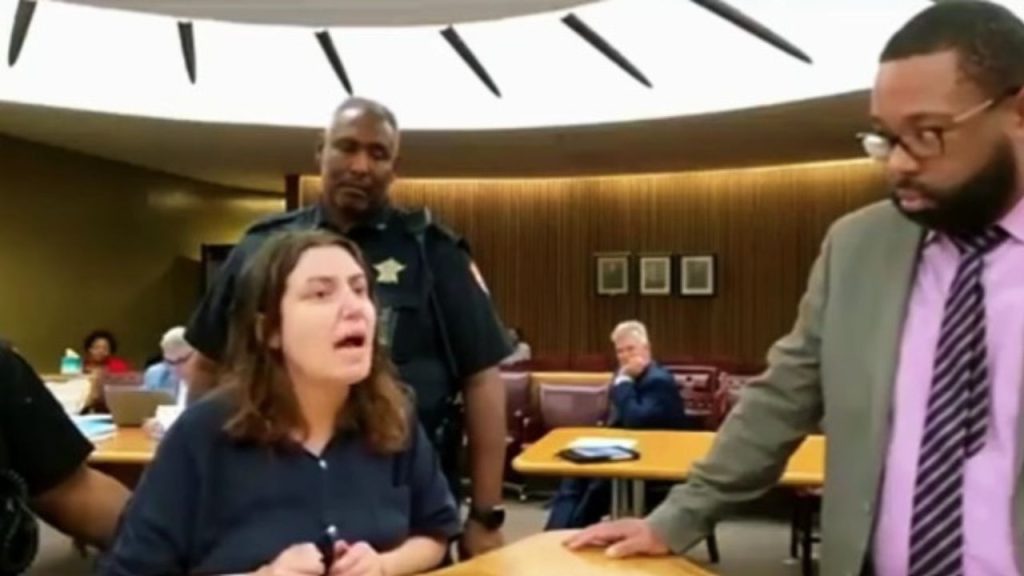



A 24-year-old Texas woman who kept interrupting a judge during a probation hearing received a five-year prison sentence after the court determined she had repeatedly failed to address her mental health, broken the terms of her supervision, and kept contacting the elderly victim in her case.
The hearing, shared by the courtroom footage channel Verdictly, focused on Atkins, who had been serving probation for a third-degree felony involving injury to an elderly person. Judge Raquel West eventually revoked that probation after finding several alleged violations to be true, explaining that the court had reached a point where it had to weigh public safety.
What made the hearing stand out was not only the sentence itself, but the visible frustration in the courtroom as Atkins kept talking over the judge, probation staff, and attorneys while insisting she had never been given a fair chance to follow through with treatment.
Probation Staff Said Mental Health Was The Main Problem
A probation officer identified in the hearing as Miss Cole told the court that Atkins’ mental health had been the central issue during her supervision.
Cole explained that appointments had been set up for Atkins, including mental health services, but that Atkins had failed to attend them.
According to Cole, Atkins had also stayed unmedicated throughout the supervision period and had kept in contact with the victim in the case, identified as her grandmother.
The defense tried to frame some of Atkins’ behavior through the lens of untreated mental health issues, arguing that more services could help her stabilize and succeed on probation.
Her attorney, Mr. Lewis, said he had spoken with Atkins many times and believed she wanted to take advantage of treatment if it were offered in a way she could actually access.
But the judge kept returning to the same point: services had already been offered.
The Judge Said Atkins Had Been Given Multiple Chances
West asked probation staff directly whether they had recognized the mental health concerns and given Atkins opportunities to take part in treatment.
Cole confirmed that she had personally made appointments for her.
That became a key part of the hearing because Atkins kept arguing that she had not been properly connected with care.
She told the judge that she had tried to set up treatment elsewhere and objected to the type of evaluation she believed probation wanted her to attend.
“I’m not a psycho,” Atkins said. “I don’t have those problems.”
The judge pushed back, clarifying that nobody was calling her a psychopath and that the evaluation was meant to figure out what kind of help she actually needed.
West pointed out that the real issue was that Atkins would not even attend the evaluation that could answer those questions.
Verdictly’s narrator criticized that response, arguing that Atkins seemed to get defensive over a label nobody in court had actually used and then rejected the help being offered because of that misunderstanding.
That interpretation may be fair, although the larger takeaway from the hearing itself was simpler: the judge believed Atkins had been given opportunities and had chosen not to take them.
Competency Evaluation Also Came Up
West also took judicial notice of an earlier competency evaluation that had been completed while the case was still pending.
According to the judge, that report found Atkins competent to stand trial and capable of understanding the proceedings.
West said that finding made it harder to accept the idea that Atkins simply did not understand what she was supposed to do.
Instead, the judge concluded that Atkins had been making choices not to comply with the programs and conditions the court had imposed.
Atkins kept trying to explain that she had not been given enough information and that some appointments or services had been hard to access.
The judge told her she did not buy that explanation.
“I don’t believe you,” West said, adding that she did not believe probation staff would simply tell Atkins to complete a program without giving her enough information to do it.
Continued Contact With The Victim Worried The Court
The hearing also addressed a no-contact condition involving Atkins’ grandmother, who was identified as the victim in the underlying case.
Testimony showed that Atkins had kept in contact with her despite the court’s order.
The defense suggested the grandmother had remained involved because of Atkins’ mental health difficulties and had tried to support her.
West, however, treated the continued contact as another serious violation in a case that already involved an elderly victim.
She said she had to weigh the safety of the public because Atkins was not following the conditions designed to reduce the risk of further problems.
That matters because the sentence was not handed down only because Atkins missed appointments or argued with the judge. The court was looking at a combination of supervision violations, ignored treatment opportunities, and continued contact in a case involving harm to an older person.
The Interruptions Continue As Sentencing Begins
Once West announced that she was finding several of the alleged probation violations true, the hearing grew more tense.
Atkins kept talking while the judge tried to make formal findings and move toward sentencing.
West warned her directly.
“Don’t talk over me,” the judge said. “I’m about to sentence you to prison.”
She then told Atkins that continuing to interrupt could make the situation worse because the offense carried a longer possible prison term.
Atkins did not stop.
She kept insisting that she was not guilty and that she had tried to deal with her medical and mental health issues.
The judge ultimately imposed a five-year sentence in the Texas prison system, with credit for any time Atkins had already spent in custody as required by law.
Judge Warned She Could Have Received More Time
Even after the five-year sentence was announced, Atkins kept interrupting.
As West tried to explain the remaining paperwork and legal consequences, Atkins kept talking about doctors, hospital visits, and why she believed she had not been treated fairly.
The judge then reminded her that five years was not the maximum sentence available.
“I’ve got five more years that I could add on to that,” West said. “I can give you up to 10.”
That warning finally drove home just how little patience was left in the courtroom.
Verdictly’s host said the repeated interruptions made it seem like Atkins was not listening to what anyone was trying to tell her, including the people who had arranged treatment and the judge who was spelling out the consequences.
The host’s commentary was blunt, but the bodycam-style courtroom footage does show a hearing in which the judge repeatedly asked Atkins to stop talking over people before finally running out of patience.
Even The Firearm Warning Became An Argument
At the end of the hearing, West began reading a standard written warning explaining that the felony judgment made Atkins ineligible under Texas law to possess a firearm or ammunition.
Atkins immediately interrupted again to say that she did not have a gun.
The judge tried to explain that the warning was something she was required to read to everyone in that situation.
Atkins kept insisting that the warning did not apply to her because she did not own a firearm.
“Good,” West finally told her. “Then you don’t have to worry about that.”
She then directed Atkins to leave with the bailiff.
Verdictly Says The Court Finally Ran Out Of Options
After the hearing, Verdictly’s narrator argued that the five-year sentence reflected how many opportunities Atkins had already been given before probation was revoked.
The host pointed to the missed mental health appointments, refusal to take part in evaluations, continued victim contact, and repeated interruptions as evidence that the court had used up less serious alternatives.
That conclusion also matches the judge’s own comments.
West did not describe prison as the first choice; she said the court had reached a point where Atkins was not doing what was required and society still had to be protected.
The hearing became dramatic because of the back-and-forth, but the larger issue was not simply disrespect toward the judge.
It was whether probation could keep working when a defendant repeatedly failed to comply with the conditions meant to address the very problems that had already brought her into court.
In Atkins’ case, West decided the answer was no, and a probation case that had included treatment opportunities and second chances ended with a five-year prison sentence.

Leave a Reply