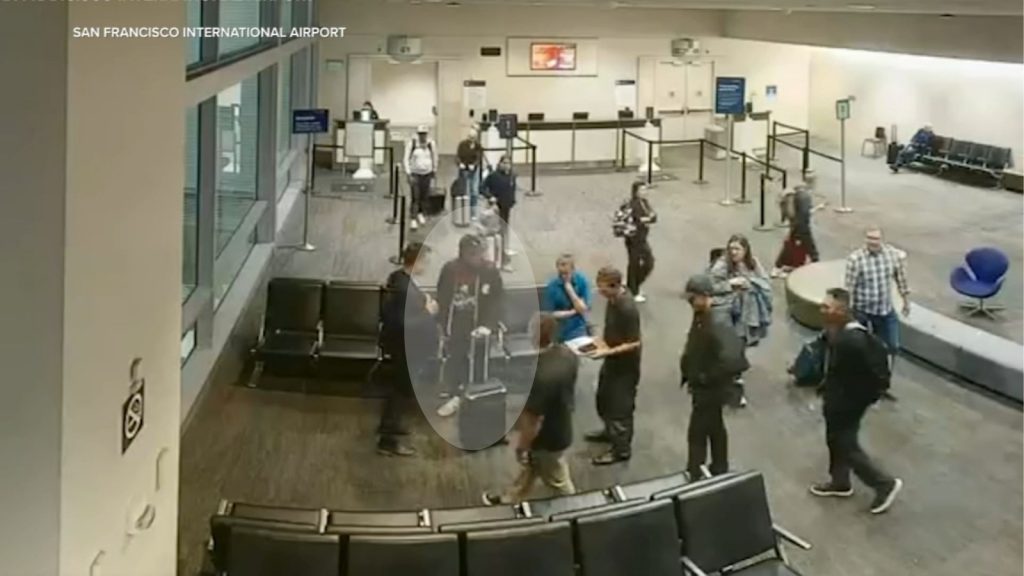


Newly obtained video shows the moment FBI agents approached former East Bay Congressman Eric Swalwell at San Francisco International Airport as part of an ongoing federal criminal investigation. The footage, obtained by ABC7 Eyewitness News through a public records request, captures Swalwell stepping off a plane wearing a black hoodie and baseball cap before investigators approach him. He appears to cooperate and is seen handing what is presumed to be his cellphone to a female agent before being escorted through the terminal into a restricted area.
The encounter at SFO was first reported about two weeks earlier. Sources familiar with the investigation previously told ABC News that federal agents seized Swalwell’s cellphone and laptop at the airport, and that one day later agents searched his Washington, D.C., home.
What the search warrant shows
According to the search warrant, which was first obtained by the San Francisco Standard, authorities executed the warrant at approximately 8:25 p.m. on Aug. 15. Court records show investigators seized a white Apple iPhone, a charging cable and adapter, and an Apple MacBook Pro. The warrant cites 18 U.S.C. 242, a federal civil rights statute, as well as “other offenses,” according to court records. That referenced criminal statute makes it a crime for anyone acting under the authority of the government to “willfully deprive” another person of federally protected rights.
Swalwell has not been charged with a crime. ABC7 Eyewitness News reached out again to Swalwell’s attorney for comment but did not receive a response.
Why an airport stop
Anthony Brass, a former assistant U.S. attorney and criminal defense attorney, said serving a search warrant at an airport can offer investigators logistical and tactical advantages. “There’s a number of advantages to meeting someone at the airport,” Brass said. “Number one, you can track the flight so you know exactly where they’re going to be.” Brass added that the presence of several federal agents can help ensure a warrant is executed smoothly.
“Having a group of people swarm you, you know, you have to comply and it just sends that message,” Brass said. “I’m not suggesting that Eric Swalwell wouldn’t comply, but it just takes away that option.”
What sources say about the broader case
Sources have told ABC News that the criminal investigation is related to the broader allegations of sexual assault. In April, Swalwell ended his campaign for California governor and resigned from Congress after multiple women accused him of sexual assault. He has denied those allegations.
Brass said that while the FBI does not typically investigate sexual misconduct allegations on their own, references to a federal civil rights statute could indicate investigators are examining whether there was any abuse of power or attempts to influence witnesses. Typically, sexual assault cases are handled by state and local authorities, but there are cases where federal authorities have purview.
“Any time you have a case where a person has power, a person has reach, you are going to suspect that there is witness dissuasion going on,” Brass said. “If you use that authority, your power to get people to not go to the authorities about you, that in itself is a case. And it’s easier to prove because the communications are going to be in that MacBook and in that cellphone.”
The federal civil rights statute at the center of the warrant
The statute cited in the warrant, 18 U.S.C. 242, is a federal civil rights law that applies to anyone acting under the authority of the government. It makes it a crime to willfully deprive another person of federally protected rights under color of law. Cases brought under the statute are prosecuted in federal court and can carry significant penalties when convictions are obtained. The statute is most commonly used in cases involving allegations of misconduct by law enforcement officers, prison officials or other government actors, and it has also been used in cases examining whether a person’s official position was used to interfere with the legal processes of others.
Reported by ABC7 Eyewitness News.

Leave a Reply