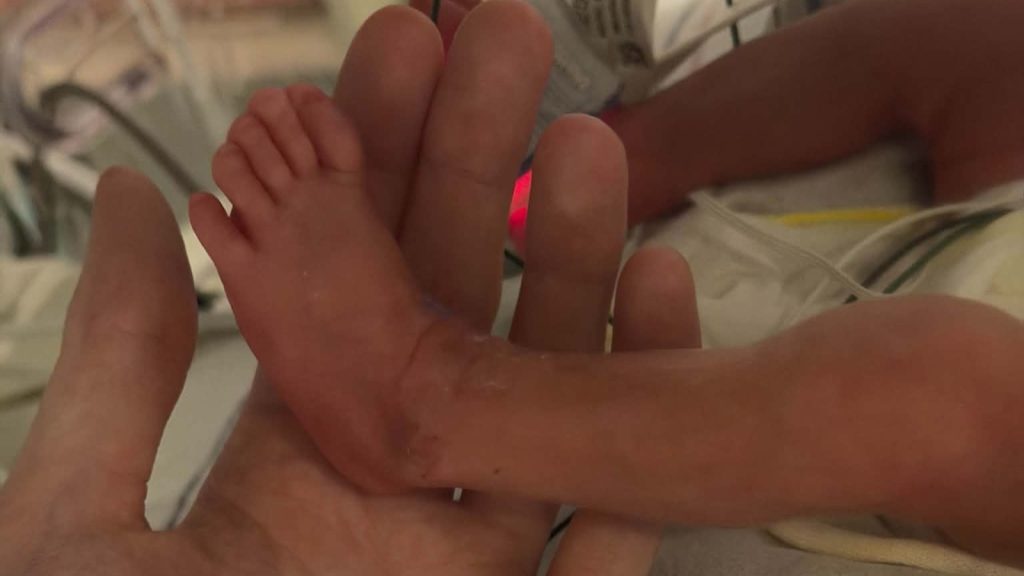


A measles outbreak in Lancaster County has spread into hospital neonatal intensive care units and is forcing people who are immunocompromised to weigh everyday activities against the risk of infection. The outbreak has now reached Geisinger Medical Center’s NICU in Danville, where an adult visitor exposed multiple infants between Friday, August 14 and Monday, August 17, according to Brittany Nicole Sponenberg.
Sponenberg’s son has been in the NICU for almost two months while his underdeveloped lungs and gut grew strong enough for regular breathing and feeding. The mother of one said she sat silent on the phone with a doctor who explained that her tiny baby had been exposed to measles.
“And he told me all of that, and I’m like, are you kidding me right now?” Sponenberg said.
The doctor told Sponenberg the visitor developed a fever and a rash on August 17 and tested positive the next day. Sponenberg said she wasn’t informed until three days later, after her son had already been transferred to a different hospital closer to home.
The Geisinger doctor characterized her son’s risk of getting measles as low, Sponenberg said, but the baby would need an injection in the top of each thigh for protection. He would be moved to an isolation room with special air circulation, and won’t be clear of the risk for 28 days, Sponenberg said.
“It really extremely upset me, because he was already having things to overcome. He had to get stabbed in the leg with something he shouldn’t had to get stabbed in the leg with yet. He shouldn’t have needed that medication yet, being that young,” Sponenberg said.
“He’s already had to overcome so many battles already. This was not a battle I wanted to add to us having to overcome.”
Of the nearly 400 measles cases confirmed by the Pennsylvania Department of Health this year, about half have been in Lancaster County. Last week, the state reported that two people with measles in Lancaster County had died, the first measles-related deaths there in 35 years.
Geisinger Medical Center is in Danville, north of Lancaster County, which has large Amish and Mennonite communities. Although Amish and Mennonite people don’t universally reject vaccines, they tend to have lower vaccination rates than the general population.
Kimberly Reichenbach, 50, of Leola has retired from her career as a corrections officer. For the past few years, she had been driving Amish customers on their regular errands.
Reichenbach said she quit driving altogether last week after she and her longtime partner, who has type 1 diabetes, separately drove clients who were sick or who had been exposed to measles. At the end of one trip, one woman said she was grateful to be able to pick up groceries because her whole family had measles.
“It’s a tough place to be immune-compromised,” said Reichenbach, who has a teen daughter. “If I get sick, who’s going to take care my family?”
Last week, another client she drives to and from her job at a bakery got into the car coughing and sneezing. Reichenbach said she didn’t believe the client’s explanation that it was a cold.
“I even came home that day and said to my boyfriend, ‘I’m really concerned about this because I know that, especially in Lancaster, it’s starting to get bad,'” she added. “I canceled everybody.”
Penn State’s Golisano Children’s Hospital warned families that someone had tested positive after being in the main lobby for two and a half hours on August 17. UPMC Children’s Hospital Emergency Department was also the site of recent exposures, according to the Allegheny County Health Department.
Last week, Dr. Jeffrey Martin, who practices at Lancaster General Health, urged people seeking medical care to “please call ahead” before they go to a hospital, clinic or urgent care if they think they might have measles.
“Calling ahead allows healthcare workers and teams to prepare and arrange for safe evaluation, minimizing exposure to others and protecting vulnerable patients who may be in waiting areas,” Martin said. “This simple step can significantly reduce the risk of spread.”
Sponenberg said she’d spoken with other parents who were also furious about the NICU exposure.
“Some babies can’t handle the loud noise from the pressure-controlled room in isolation, so they are having a rough time, especially the really, really little ones,” she said.
In response, Geisinger changed its screening protocols. Going forward, only parents or legal guardians will be allowed in the NICU or its nearby children’s hospital, and only as long as they don’t have signs or symptoms of measles. They will be encouraged to wear a surgical mask before entering the unit.
“These screenings are in place to best protect our patients, visitors and staff as measles cases are rising in the area,” Geisinger said in a statement.
Dr. Michael Fitzpatrick, Geisinger’s Central Region chief medical officer, said in a statement on the hospital’s website that the screening process relies on accurate and complete information being shared at the time of entry.
“We understand how important it is for parents and immediate family members to be present with loved ones in the NICU, and we did not make this change in visitation policy lightly,” Fitzpatrick said. “We carefully considered the impact on families before determining that these temporary restrictions were necessary to protect our most vulnerable patients.”
Sponenberg said she doesn’t understand why the hospital doesn’t require visitors to show vaccination records before they can come in.
Last year, about 88% of kindergartners and 83% of seventh-graders started school fully vaccinated against measles in Lancaster County, far lower than the 95% threshold that creates community protection. While some public schools report nearly all students have been vaccinated against measles, mumps and rubella, some Mennonite and Christian schools in Lancaster County report vaccination rates below 50%.
Reichenbach said it’s been alarming to her to see how casually her neighbors treat measles. She was supposed to go visit her young niece and nephew this week, but her doctor advised against it. The doctor told her that because she and her boyfriend are immunized, they will probably be fine after their exposures, but “they’re babies. They’re toddlers. I wasn’t going to risk it.”

Leave a Reply